RAKURAI · Dismounted counter-UAS

Counter-UAS for every Soldier.

A sub-1 kg, one-handed counter-small-UAS platform engineered for general issue. RAKURAI denies command, navigation and video links across ISM, GNSS and Wi-Fi bands.

RAKURAI handheld counter-UAS system
<1 kgComplete system mass
>1 kmEffective range
>2 hContinuous · all bands active
0.4–6 GHzISM · GNSS · Wi-Fi
RAKURAI is preparing for field trials.Designed and built in Australia
The system

Counter-UAS in the palm of your hand.

Designed to be carried as a routine secondary item, not allocated to one specialist and shared by the rest of the squad.

RAKURAI is a dismounted electronic countermeasure system for small unmanned aircraft. It is designed to disrupt the control, navigation and data links hostile platforms rely on before the threat is overhead.

The platform can be fielded as a complete C-UAS system or used as a programmable development platform for primes, OEMs and integrators building proprietary signals and software on MILLIBEAM RF hardware.

400 MHz–6 GHz
Wideband coverage

Coverage spanning ISM, GNSS and Wi-Fi-dependent control, navigation and data links.

One hand
Operator fit

Designed for use while the Soldier retains access to a primary weapon or other equipment.

>2 hours
Measured endurance basis

More than two hours with all bands active under continuous transmission, not standby.

SDK in development
Programmable platform status

The programmable signal layer is being developed for partner-created waveforms, operating modes and software-layer IP.

The squad-level capability gap

Doctrine says every Soldier. Hardware still says specialist.

Current handheld systems force units to concentrate protection in one operator or fire team, the opposite of what dispersed operations require.

“Countering small unmanned aircraft is the responsibility of every Soldier and unit.”US Army ATP 3-01.81 · Counter-UAS
Typical handheld category
Every-Soldier requirement
2–7 kg on top of weapon, plates, ammunition and water
Under 1 kg
Less than one hour at full duty
Multiple hours continuously
Narrow ISM and GNSS coverage
Military and civilian-threat links
Two-handed, aimed operation
One-handed operation
Dedicated, trained specialist
Basic familiarisation

A dispersed patrol, building-clearance team or defensive position cannot rely on one specialist always being in the right place, with line of sight, when the UAS appears.

The differentiator

It is not one number. It is the combination.

Handheld jammers exist. Multi-band jammers exist. Multi-hour systems exist. No one has put all three in one hand. What changes the operational and procurement calculus is achieving the full combination in one envelope, small enough, persistent enough and capable enough for general issue.

<1 kgRoutine secondary item
>1 kmEffect before overhead
>2 hStays on through risk
0.4–6 GHzMultiple threat links
GENERAL-ISSUE CAPABILITYThe full operating envelope in one handheld system
What it disrupts

Target the links the aircraft depends on.

RAKURAI is designed around the signal pathways that enable reconnaissance, navigation, command and terminal attack.

Command

Disrupts control links between the aircraft and operator, reducing the operator’s ability to manoeuvre or prosecute a target.

Navigation

Denies GNSS inputs used to reach, navigate toward or hold a target across supported satellite-navigation services.

Video & data

Disrupts links used for live imaging, reconnaissance, situational awareness and terminal guidance.

Operational fit

Protection that moves with the formation.

The platform is designed for distributed use across dismounted, mobile and fixed-site operating contexts.

Representative small unmanned aircraft threat
01 · Dismounted patrol

Coverage moves with the Soldier.

Protection remains organic to dispersed patrol elements rather than being concentrated in one specialist position.

02 · Fixed-site perimeter

Every observation point carries capability.

Guard positions and dispersed perimeter elements can hold local protection without waiting for a central team.

03 · Vehicles & small craft

Handheld where larger systems do not fit.

A compact option for convoy, patrol-vessel and small-platform contexts where vehicle-mounted architectures are impractical.

How to work with us

Field it.
Build on it.
Advance it.
Invest in it.

Engage at the level that fits your programme: evaluate the complete system, integrate the developing programmable platform, jointly shape the next capability, or back the company building it.

Field RAKURAI

A complete counter-small-UAS system for defence primes, programme managers, procurement teams and partner-led evaluation.

Discuss field evaluation →

Build on it

Engage with the RF architecture, components and developing programmable signal layer as a foundation for partner-developed capability.

Discuss integration →

Advance it

Work with MILLIBEAM on allied research, integration priorities and capability development shaped around confirmed programme needs.

Shape the programme →

Invest in it

Back the sovereign RF capability behind the platform: silicon, radio architectures and deployable systems designed and built in Australia.

See the investor overview →
Why the envelope is possible

The specification is a systems-engineering result.

RAKURAI is not a collection of catalogue parts assembled inside an enclosure. The antennas, RF front end, power system, signal chain, thermal design and mechanics are engineered against one mission envelope by one team.

That vertical integration allows each layer to be optimised for the actual operating conditions of the device instead of the fixed design points of general-purpose components.

01

System-specific antennas

Radiation efficiency, gain pattern, feed structures and enclosure interaction designed together.

02

GaN RF power amplifiers

Power, efficiency, bandwidth, supply range and thermal behaviour engineered for the handheld duty profile.

03

Power electronics

Battery management, conversion, sequencing and protection designed to preserve operating time.

04

Signal generation

Programmable operation across bands, modes and partner-developed software.

05

Mechanical, thermal & EMI integration

Enclosure, antenna placement, thermal paths and electromagnetic interactions resolved from the start.

SEMICONDUCTOR CHIP → ANTENNA → RADIO → POWER → FIELDED SYSTEM
Technology beneath RAKURAI

Built on MILLIBEAM-designed RF technology.

RAKURAI draws from MILLIBEAM’s broader RF components portfolio, with antenna, semiconductor, radio and system capability engineered within one organisation.
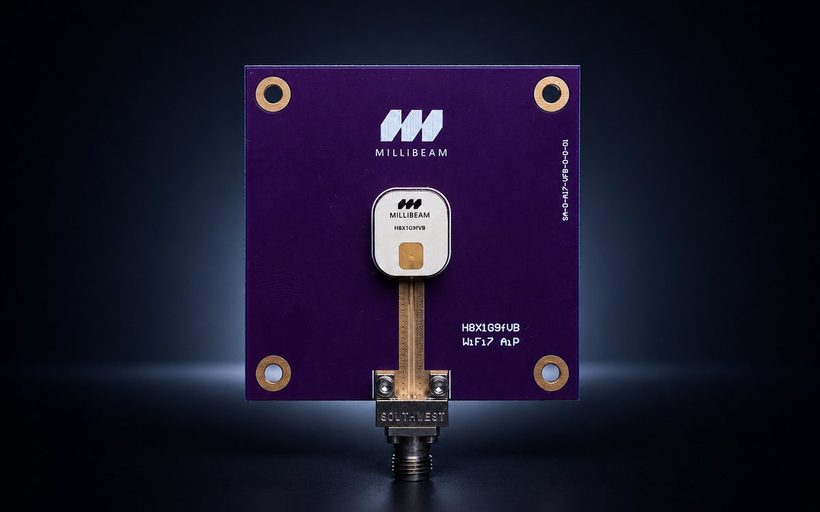
MILLIBEAM antenna-in-package component
Representative MILLIBEAM antenna and RF component capability
From component to platform

The RF technology behind the system.

MILLIBEAM develops antenna, semiconductor, radio and systems technology as one connected RF capability, creating a stronger foundation for compact fielded platforms.

TECH 01

Power amplifiers

Designed in-house to support the efficiency, operating range and power-management strategies needed by compact, persistent RF systems.

TECH 02

Custom antennas

Designed against the actual enclosure, RF chain and mission bands rather than selected from a generic catalogue.

TECH 03

Programmable architecture

Supports proprietary waveforms and operational modes while allowing partners to retain software-layer differentiation.

0.4–30 GHzBroader MILLIBEAM RF portfolio span
11 familiesReusable front-end product families
Chip to systemOne accountable engineering stack
Sovereign capability

Australian-designed. Allied-aligned.

RAKURAI is built on Australian-held RF and system IP, including Australian-designed GaN MMIC technology. The programme supports the broader objective of reducing dependence on a narrow, foreign-concentrated defence RF supply base.

Australian RF and system IPCore semiconductor, antenna, radio and systems engineering developed within MILLIBEAM.
Government-supported developmentCapability development supported through Australian industry and defence innovation programmes.
C-UAS programme relevancePositioned for conversations around land-based C-UAS evaluation, integration and allied collaboration.
Allied capability relevanceRelevant to allied priorities in electronic warfare, sovereign RF supply and advanced counter-UAS capability.
Current status

Ready for partner-led evaluation.

RAKURAI 1.0 is in laboratory testing and preparing for field testing, while evaluation and integration conversations proceed in parallel.

Testing status

Laboratory testing is underway and field testing is being prepared, with component performance characterised against target specifications.

Discuss evaluation readiness →

Partner evaluation

Open for discussion with defence primes, programme teams and government stakeholders evaluating squad-level counter-small-UAS capability.

Start the evaluation conversation →

Integration path

Technical conversations are open for integration, system development and access to the technical brief and supporting material.

Discuss integration →
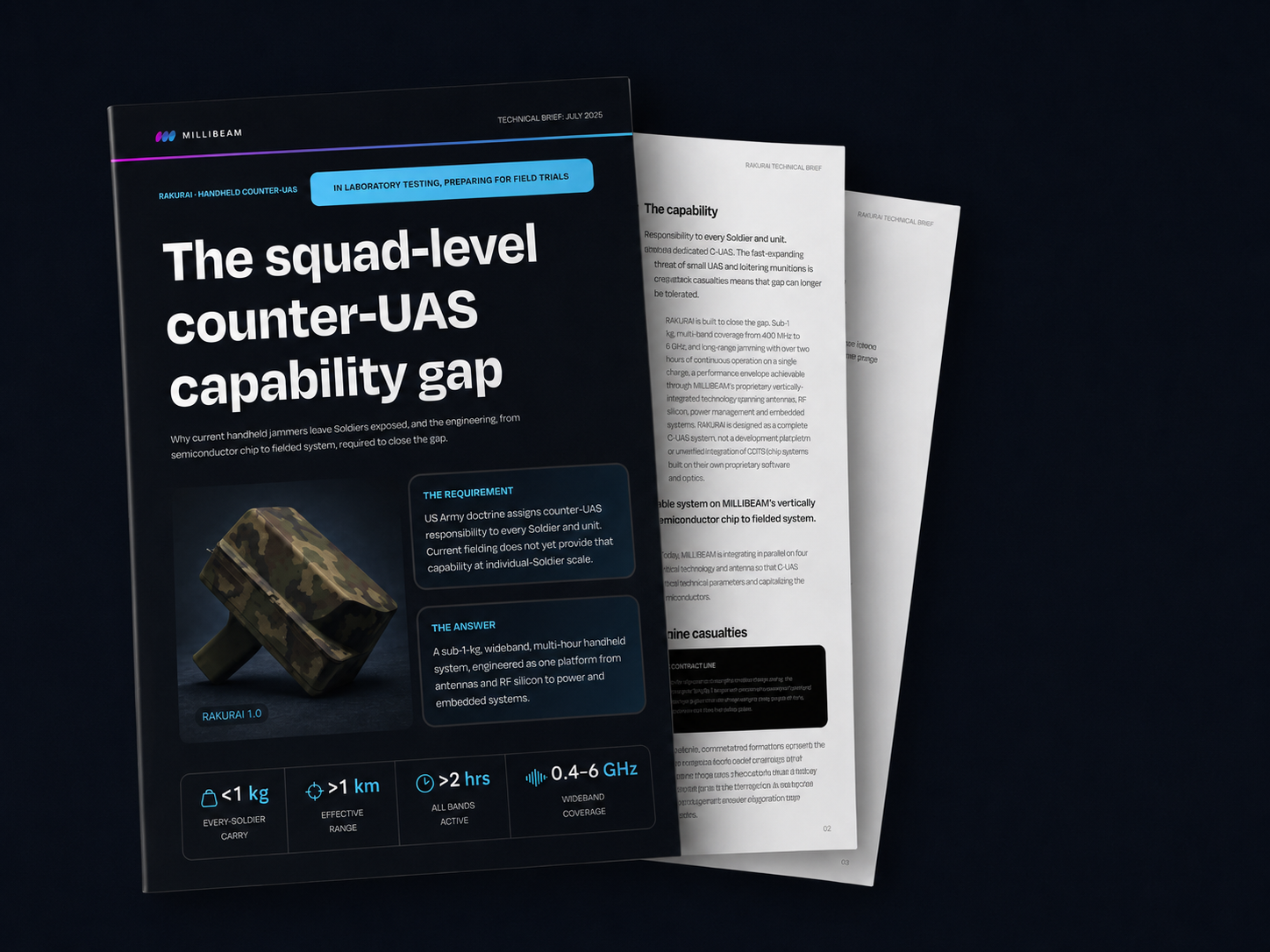
Engineering credibility

One accountable engineering stack.

RAKURAI is developed by a vertically integrated RF and systems team spanning semiconductor design, antennas, power electronics, embedded systems and platform integration.

RF devicesPower-amplifier and front-end technology engineered against the handheld operating envelope.
Antenna systemsIn-enclosure antennas, matching and electromagnetic integration designed around the complete device.
Power and thermalBattery, conversion, sequencing and heat-management decisions made as one architecture.
Platform integrationMechanical, embedded and signal-generation layers brought together under one engineering responsibility.
Preview pages from the RAKURAI technical brief
TECHNICAL BRIEF

Request the RAKURAI technical brief.

Submit your details and the MILLIBEAM team will review your request and follow up by email.

Your details are used to process your RAKURAI technical brief request. Nothing else.

Thanks. Your request has been received. The MILLIBEAM team will review it and follow up by email.
Something went wrong. Please try again or contact marketing@millibeam.com.
RAKURAI partner engagement

Bring us the operational requirement.

Discuss partner-led evaluation, integration, system development or access to the technical brief directly with the team engineering the RF architecture and complete platform.

RAKURAI handheld counter-UAS system
Acknowledgement of Country
MILLIBEAM acknowledges the Traditional Custodians of the lands on which we work and pays respect to Elders past and present. We recognise their continuing connection to land, waters and culture.
MILLIBEAM acknowledgement artwork