From Platoon to Soldier: The Engineering and Cost-Scaling Case for C-UAS
Drones now reach every soldier in contact, but counter-drone protection still sits at platoon level. Dr Venkata Gutta on why issuing C-UAS one per soldier is an engineering problem and a cost problem, and why both trace back to how the RF chain is designed.
Imagine a squad in the thick of a battle, under direct attack from drones. In the chaos, one infantry soldier is displaced and ends up well away from the specialist operator carrying the counter-UAS equipment. There is no guarantee in a battle that the operator will be right next to you at any point in time. So the question I would ask is this: who is protecting that soldier from the drones, and what could we have done to equip them better? In today's scenario, the honest answer is that not much can be done for that soldier.
Every engineered system is the outcome of a negotiation with constraints. In counter-UAS, the constraint that decides the outcome is rarely written into the specification. It is set by the soldier who has to carry the system, and by the force that has to buy it in very large numbers.
How the threat reached the individual
Western officials have stated that drones now cause somewhere between 70 and 80 per cent of military casualties in Ukraine, on both sides. Russian military medical reporting suggests that FPV strikes account for more than three quarters of the injuries their soldiers suffer in low-intensity fighting. Early in the war, drones were used against tanks and artillery. Nowadays they are used against individual soldiers, and the threat is expected to rise.
To put the scale in perspective, Ukraine's commander-in-chief says Russia plans to produce more than seven million FPV drones this year, in the order of twenty thousand a day. Ukraine's own security council says its industry has the capacity to build more than eight million a year. Each of those drones costs a few hundred US dollars (around four hundred by some estimates), and each one is capable of finding and striking a single person.
Our protection sits somewhere else. Dismounted counter-UAS, where it exists at all, is typically held at platoon level or higher. One system is shared across twelve to thirty people spread over hundreds of metres of ground, so most of the platoon is outside its coverage most of the time.

Our allies can see the gap. The UK Ministry of Defence has asked industry what soldier-worn counter-drone equipment is available for Ukraine, and the US Army has requested funding for squad and individual soldier-level systems. Closer to home, Dr Carl Rhodes of the Australian Army Research Centre concluded in 2024 that defence against small drones has to reach the tactical level, with detection and defeat happening at platoon or section. These are requirements and funding requests rather than capability fielded at scale.
I would argue that this is only partly a policy problem. Policy is hamstrung by the fact that the technology does not yet exist to give an individual soldier counter-drone protection at a weight, size and cost that makes issuing it practical. People with all the right intentions still cannot equip every soldier with a device that is heavy, bulky and expensive.
Two questions with a common cause
When people ask why counter-UAS cannot simply be issued one per soldier, it sounds like one question. In practice it is two. The first is whether a soldier can carry it over a full day on top of the load they already have, which is an engineering question. The second is whether the force can afford tens of thousands of units, bought, maintained and replaced, which is a question of how cost scales. My argument is that both problems share the same root cause, so they can share a solution.
What the soldier already carries
A modern dismounted soldier carries around fifty kilograms, and often more. Australian defence research has pointed to around fifty kilograms as a typical load on operations in Afghanistan, and industry analysis suggests that up to a quarter of that can be batteries. Every gram added competes with water, ammunition and communications. If a counter-UAS system is heavy, or hungry for power, it does not get carried.
Where the weight comes from
I will try not to be too technical here. A counter-drone effector works by generating radio power across a wide spectrum and radiating it so that it disrupts the drone's communication link. The part that generates that power is the power amplifier (PA). It takes a low-level signal and turns battery energy into radio energy, and whatever it does not convert is lost as heat. That is the natural tendency of all semiconductor devices.
A simple illustration shows why this matters. An amplifier running at 30 per cent efficiency turns seven of every ten watts it draws into heat. At 60 per cent efficiency, it is four in ten. For the same RF output, that means roughly half the battery, and far less heat to get rid of. Heat needs metal to conduct it away, so a less efficient system becomes bigger, bulkier and heavier. Lost efficiency comes back either as more battery, which is more weight, or as less endurance, which is less protection. In this way, a single figure on an amplifier datasheet ends up on the soldier's back.
I want to emphasise, though, that size, weight and power (SWaP) goes beyond the amplifier. The power has to leave the device, and that is the antenna's job. Typically an amplifier is bought from one place and an antenna from another, and the two are joined with connectors and a cable. That cable has loss, which is a fundamental property you cannot avoid. Say you generate 10 watts and lose half of it between the amplifier and the antenna; you only have 5 watts to radiate. To make up the difference you need more amplifier elements in parallel, which means more power drawn, more heat and more metal.
The antenna also has its own physics. The area over which an antenna radiates, its aperture, is linked to frequency, and the lower the frequency, the larger the aperture has to be. To cover the bands small drones use, the system has to work down into the hundreds of megahertz, and at 400 MHz the wavelength is 75 centimetres. You cannot simply make the antenna smaller than the physics allows without losing performance. So you can have an amplifier with very good SWaP properties, but if the antenna cannot radiate that power efficiently, you are wasting it anyway.
The third part is signal processing. Detection and processing run continuously, so the digital architecture draws power the whole time the system is switched on, and how it is designed shapes endurance as much as the amplifier does.
Amplifier, antenna and processing therefore form one coupled chain, and weight, endurance and heat all trace back to how well that chain is designed as a whole.
Designing the chain rather than assembling it
Most handheld systems today are built by integrating off-the-shelf modules: an amplifier from one supplier, an antenna from another and a processing board from a third. Each may be a good product, but each is designed to its own general-purpose specification, with its own margins, housing and connectors. A semiconductor manufacturer designs its parts to serve base stations, phones and many other applications at once, so it is not designing specifically for a soldier who has to carry the system all day. An integrator can optimise how those modules fit together. What an integrator cannot do is reach inside them and make the trade-offs that would have produced a far more efficient system.
At MILLIBEAM we approached this from what I would call the cellular level. What I mean by that is the semiconductor components themselves and how they come together. We design the chips, the antennas, the power management and the signal processing together, as a tightly integrated system on a proprietary hardware architecture. Miniaturising the devices lets us remove cables and connectors along with the energy they lose, which means fewer elements inside the device. That makes it smaller, and because less heat is generated, it also needs less bulk and metal around it. On the antenna side, we have not broken any physical rules. We took antenna structures that are normally very hard to manufacture and found ways to realise them in low-cost materials, within the physical bounds, so the antenna is both small and efficient.
There is a second reason this matters. Drones are evolving very fast, and a counter-drone system has to stay one step ahead of them. When you depend on other companies' components, you also depend on their roadmaps, which may not match yours. Building the chips and antennas yourself means you can iterate and innovate faster than the threat evolves.
The cost of protecting one soldier
On affordability, I would propose a different metric. Instead of asking what a counter-UAS unit costs, we should ask what it costs to protect one soldier. When a system sits at platoon level, its price is spread across thirty people, but its protection is not, so the true cost per protected soldier is far higher than the price tag suggests. Dr Rhodes makes a related point: firing missiles worth millions at drones worth thousands is unsustainable in a long conflict.
If the force wants thirty units where it once bought one, on anything like the same budget, unit cost has to fall by close to an order of magnitude. We are not talking about a few percentage points. Off-the-shelf stacks make that very difficult, because margin is added at every layer of the supply chain. When you own the core technology, the cost curve scales differently as volume grows from dozens of units to thousands. Unit price is also only part of the cost. Batteries, charging, maintenance, spares and training all count, and a lighter, simpler system reduces each of them.
Australia's 2026 National Defence Strategy commits up to seven billion dollars to counter-drone capability over the next decade. That sits within a wider commitment of up to twenty-two billion for drones, counter-drone and autonomous systems, and the Integrated Investment Program specifically calls for dismounted systems to protect deployed forces. There is also a sovereign capability dimension. Dr Oleksandra Molloy's research for the Army Research Centre, based on interviews with Ukrainian operators and industry, found that drone production there still depends heavily on imported microelectronics and processors. She recommends sovereign drone and counter-drone capability for Australia as an urgent priority, and owning the design and IP of the RF chain is a large part of what that means in practice.
What this looks like when built
RAKURAI is the system we built with this approach. The complete system weighs under one kilogram, runs for more than two hours with all bands active, covers 0.4 to 6 GHz and delivers a jamming-to-signal ratio (JSR) of 34 dB at 1.2 kilometres. These figures come directly from designing the chain as one system. Our goal from the start was a device approaching the size of a mobile phone. We will run into thermal and size challenges as we push further, but there is still room to go within what is physically possible.
To be clear, RAKURAI is not intended to be the whole answer. It is the soldier-level layer in a layered defence, alongside kinetic and vehicle-mounted systems, since no single effector can defeat every drone.
Go back to that soldier in open ground with a drone overhead. This time they are carrying their own protection. It is light enough that they did not have to give up water or ammunition for it, and small enough that they do not need a specialist operator nearby. It is also affordable enough that everyone in their section has one too. Getting there involves an engineering problem and a cost problem, and both are solvable if the whole chain is designed rather than assembled. The threat was issued one per soldier, and the protection has to be too.
Both of the Army Research Centre's studies recommend a counter-drone centre of excellence, where industry can test and refine systems alongside the Army. We would welcome the chance to work with the Army, industry and test and evaluation partners towards that.
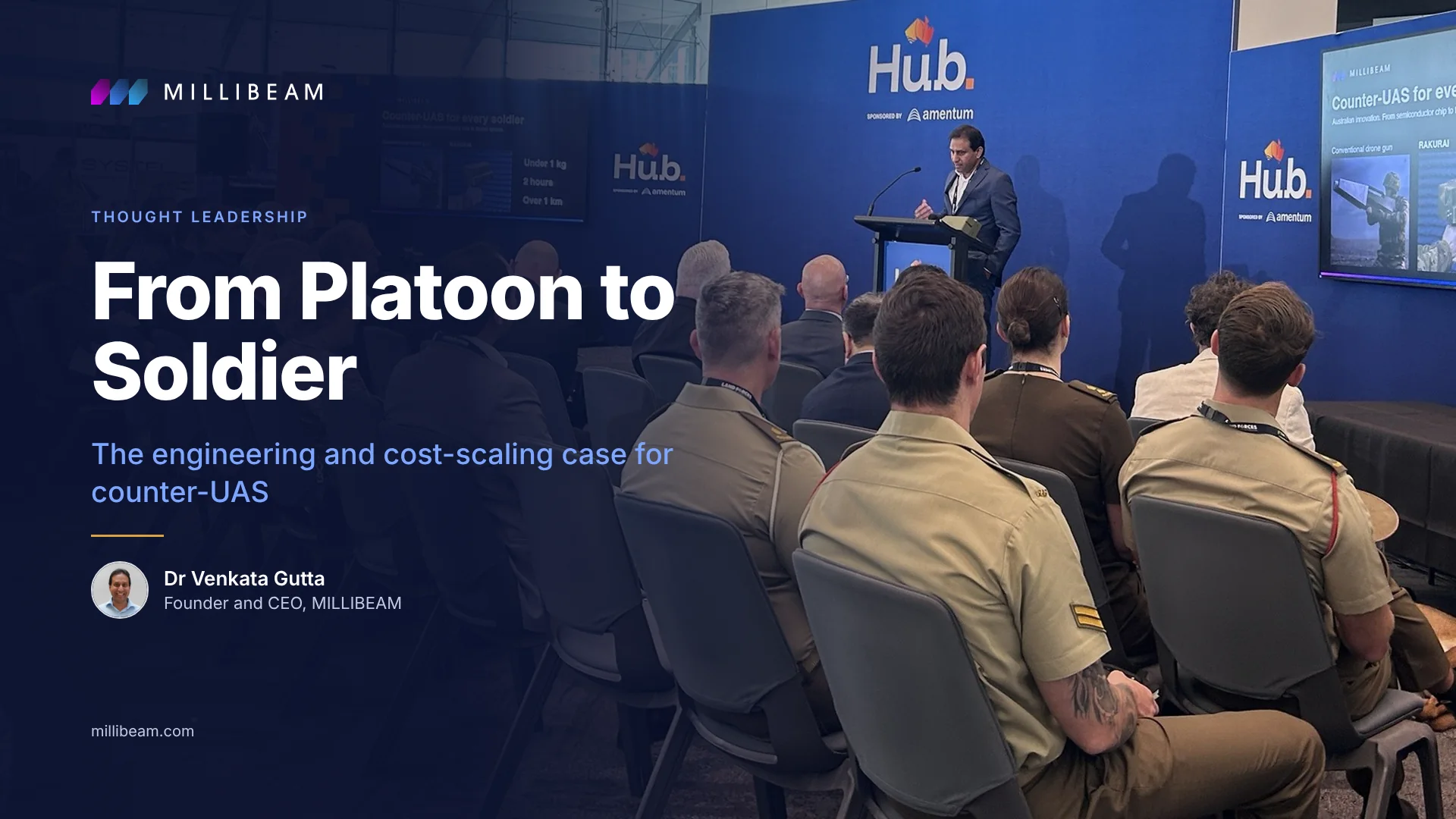
Dr Venkata Gutta is Founder and CEO of MILLIBEAM. This article is adapted from his presentation at Land Forces 2026.
Designed in silicon. Proven in the field.
The parts discussed here are designed, characterised and shipped by MILLIBEAM. Browse the catalogue, filter by band and package, and request a datasheet.
