H4Q1H1: X-Band GaN PA for Radar, EW and Satcom
X-band spans 4 GHz of spectrum supporting radar, deep space communication, and electronic warfare. The H4Q1H1 from the MILLIBEAM HEAVISIDE product line supports all three — 8–12 GHz, 5W, 37 dB gain, 40% fractional bandwidth, unconditional stability DC to 40 GHz.
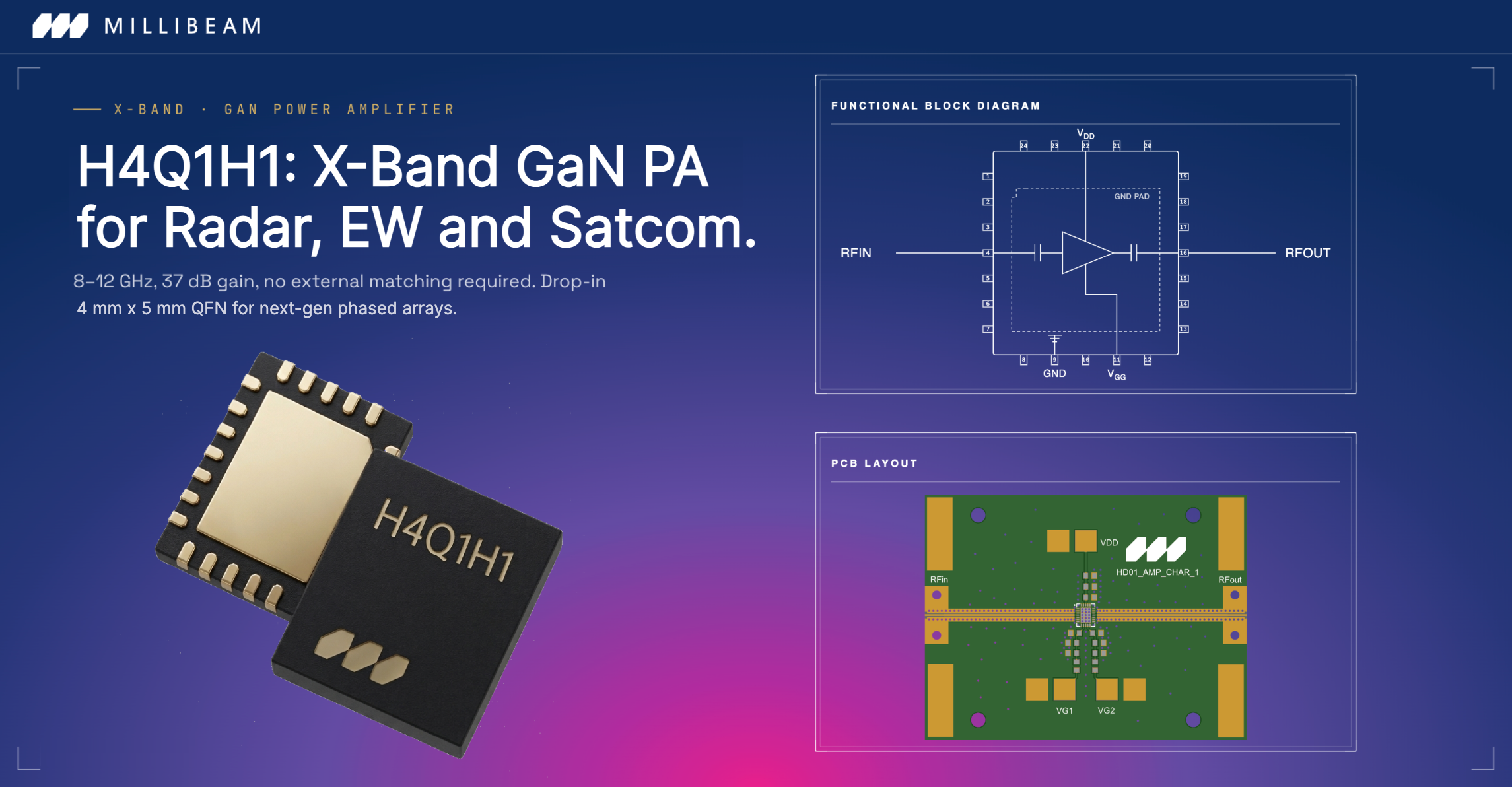
X-band spans 4 GHz of spectrum supporting a diverse range of defence applications: radar, deep space communication (ITU-allocated), and electronic warfare, including jamming and detection. The H4Q1H1 from the MILLIBEAM HEAVISIDE product line supports all three.
Device Specifications
The H4Q1H1 is an 8–12 GHz, 5W GaN RF power amplifier (PA) with 37 dB small-signal gain, ±1 dB flatness, and peak power-added efficiency (PAE) of 39%.
The device has unconditional stability from DC to 40 GHz and is designed to minimise RF and DC connections, with a single pin each for RF in, RF out, VGG, and VDD biasing. It is 50 Ω matched at both input and output and requires no external matching or biasing elements. It is available in a 4 mm x 5 mm QFN package or as a stand-alone die.
Simplifying Phased-Array Integration
Half-wavelength array element spacing is approximately 15 mm at 10 GHz. A 4 x 5 mm footprint allows tight lattice integration without sacrificing element density.
A gain of 37 dB removes the need for pre-driver and driver stages. This directly simplifies SWaP constraints for EW and jammer payloads, reducing component count, board area, and power overhead in front-end module design.
Wide 40% Fractional Bandwidth
The H4Q1H1 achieves a fractional bandwidth of 40%, compared to 10–15% typical for RF PAs. PA designs at this bandwidth must simultaneously overcome gain flatness and PAE challenges. Achieving both requires:
- Harmonic control internally within the device
- Impedance transformation across the bandwidth
- Minimising the impact of package parasitics
- Achieving the optimal trade-off between losses, bandwidth, and stability
These requirements often also inform process selection and transistor stage sizing to avoid excessive power dissipation in the driver stages. The H4Q1H1 addresses all of these competing constraints to deliver very wide-bandwidth operation.
Unconditional Stability
GaN has high gain at low frequencies. An X-band device without proper stabilisation can oscillate at UHF or L-band, well outside the characterisation window of a narrowband bench setup. When it occurs, this is destructive.
Phased array front-ends carry a particular risk: element coupling creates impedance environments that are not predictable at design time. DC-to-40 GHz unconditional stability eliminates that failure mode under any passive termination.
Integration Notes
- VDD: 25 V
- Gate bias (approximately -2.8 V) applied before drain
- Target IDQ: 360 mA
- PCB requires 50 Ω lines at input and output
- Single 4.7 µF capacitors per bias rail, placed close to the package pins
- Device characterised under pulsed-CW conditions
Contact MILLIBEAM for operating settings specific to your application.
Designed in silicon. Proven in the field.
The parts discussed here are designed, characterised and shipped by MILLIBEAM. Browse the catalogue, filter by band and package, and request a datasheet.
