UAV SAR, Marine Radar, EW: One X-Band Front-End
X-band phased-arrays for UAV SAR, marine radar, and EW share one front-end constraint: SWaP at the element level. The H4Q1H1 PA paired with the H8Q1N4FVB AiP eliminates pre-driver stages and the 2.5–3 dB cable and connector loss at the antenna interface — fewer elements, smaller aperture, lower DC draw.
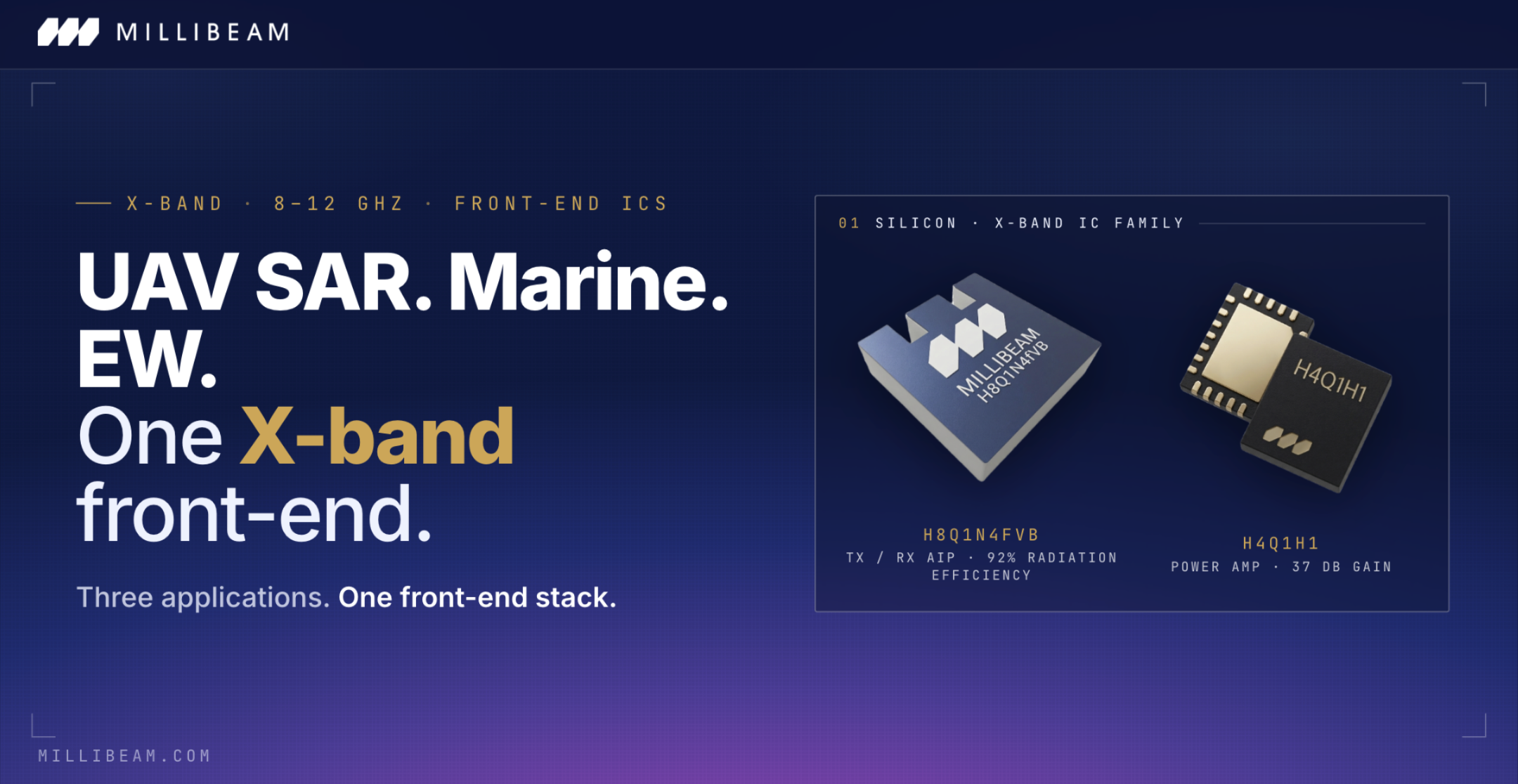
X-band phased-arrays or synthetic aperture radars are proliferating across three applications, each facing the same RF front-end constraint.
UAV SAR
Synthetic aperture radar (SAR) is moving from satellites and large aircraft onto small UAVs. X-band frequencies are a popular choice, enabling all-weather, sub-metre-resolution imaging through cloud, fog, and moderate rain. Deployment of SAR on a UAV is tightly constrained by the number of power amplifier stages, RF interconnect losses, and heatsink mass, all which trade off against flight time, payload capacity, and the power budget.
Marine and Navigation Radar
Marine and navigation radars are replacing rotating antennas on small vessels. Solid-state X-band phased arrays have no moving parts, fit compact radomes, and steer electronically. The challenges come in the form of array size, radome size and DC power draw.
EW
Direction finding and signal interception at X-band require phase-coherent apertures with fast electronic steering across 8–12 GHz. UAV and man-portable EW payload envelopes rule out gimballed antennas. The array has to be compact without sacrificing aperture coherence.
The Common Constraint: SWaP at the Element Level
Conventional front-ends connect the PA to the antenna via transmission line and RF connectors. At X-band that interconnect costs approximately 2.5–3 dB. Driver amplifier stages add to the DC power consumption and contribute to heat dissipation. In a 64-element array, these penalties compound per element.
A Dedicated X-Band AiP, Not a Repurposed Ku-Band Antenna
Many X-band antenna solutions are adapted Ku-band designs, a shortcut that compromises radiation efficiency and gain flatness across 8–12 GHz. The H8Q1N4fVB is designed as a dedicated X-band AiP from the outset. With a 7 mm × 7.5 mm footprint and 92% average radiation efficiency (90–95% across the band) and surface-mountable implementation, it solves the X-band power losses.
H4Q1H1 + H8Q1N4fVB: Reducing Array Size and Complexity
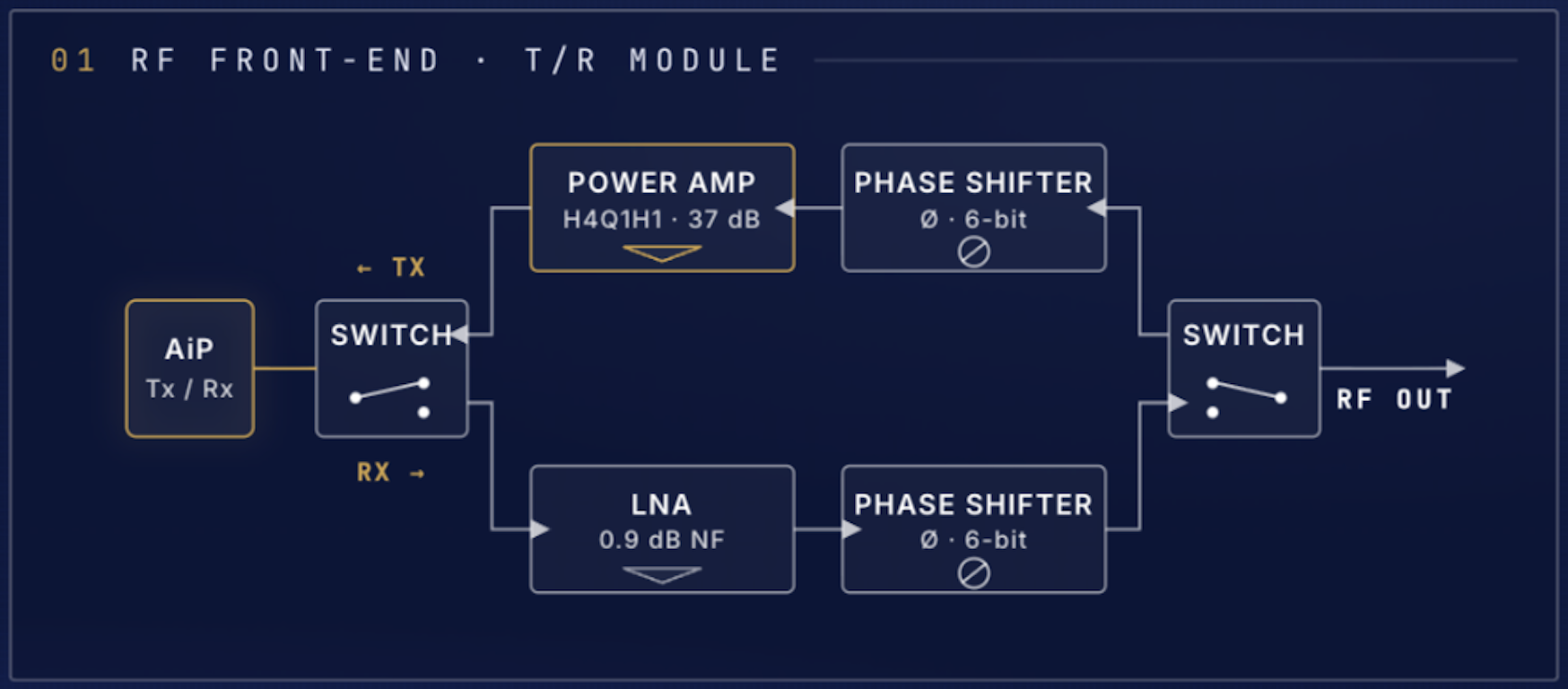
H4Q1H1 provides 37 dB small-signal gain across 8–12 GHz. No pre-driver or driver stages required. Shorter transmit chain, lower DC consumption, lower thermal load per element. Peak PAE of 41% scales heatsink mass down accordingly.
The H8Q1N4fVB mounts directly at the PA output. Removing the cable and connector eliminates the 2.5–3 dB loss at the antenna interface. Each element radiates nearly twice the power of a conventionally cabled design. For a given EIRP target, the H4Q1H1 + H8Q1N4fVB combo results in fewer elements, smaller aperture, lower DC power draw. On a drone-mounted SAR, this translates directly to flight time and mission payload.
Availability
H4Q1H1 — X-band GaN PA
Frequency: 8–12 GHz · Small-signal gain: 37 dB · Peak PAE: 41% · Status: Simulation models and evaluation units available now
H8Q1N4fVB — X-band AiP
Frequency: 8–12 GHz · Footprint: 7 mm × 7.5 mm · Radiation efficiency: 92% average (90–95% across the band) · Status: In active development
H4Q1H1 is part of the MILLIBEAM HEAVISIDE GaN PA portfolio. Contact MILLIBEAM for integration details.
Designed in silicon. Proven in the field.
The parts discussed here are designed, characterised and shipped by MILLIBEAM. Browse the catalogue, filter by band and package, and request a datasheet.
